
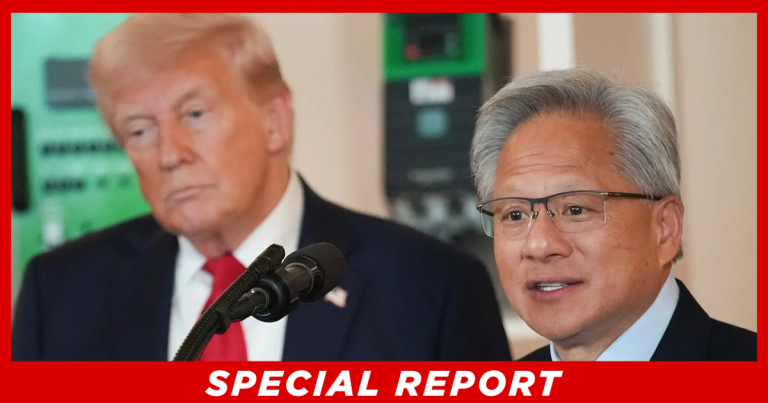
In warfare, the most consequential moves are the ones nobody sees until the board has already changed. When Jensen Huang walked back into Nvidia headquarters this weekend to a standing ovation from employees, the headlines wrote themselves: the prodigal founder returns, stock soars, crisis averted. But the real story wasn’t playing out in Santa Clara. It was playing out in Washington.
As we reported Monday, Huang’s reinstatement followed a turbulent two weeks after his resignation amid reports of extramarital affairs, including one with an alleged Chinese spy. What we didn’t know then was who pulled the strings – and why. Without its most visible champion, America’s open-weight AI ecosystem was suddenly rudderless, and the people who noticed weren’t just in Silicon Valley.
For those less familiar with the landscape, open-weight models are AI systems whose core architecture is publicly available – any developer or company can download, modify, and build on them. They’re the free-market alternative to the walled gardens run by companies like Anthropic and OpenAI. China already leads in open-weight AI development, and with Huang sidelined, the competitive landscape tilted further in Beijing’s favor. Meanwhile, Anthropic’s CEO Dario Amodei had been lobbying Washington for tighter chip export controls that would conveniently kneecap both Chinese competitors and Nvidia’s international business in one stroke. Funny how that works.
A call from the Oval Office
Then came the intervention nobody expected.
From Reuters:
US President Donald Trump and Vice President JD Vance personally intervened in Nvidia’s decision to reinstate CEO Jensen Huang over the weekend, convinced he alone protected American-made open-weight AI models, people familiar with the matter said on Monday. Open-weight AI models are systems whose core components are publicly available for users to download, modify and adapt for specific tasks. Their growth has become a major business opportunity for Nvidia because they broaden demand for the company’s chips and computing infrastructure beyond a handful of large AI developers.
According to multiple reports, including from AP, the White House viewed Huang as a critical check on the growing monopoly power of closed-model AI developers. Trump reportedly called Nvidia’s board directly. Ask yourself: when was the last time a sitting president called a corporate board to reinstate a CEO? That alone tells you how high the stakes are.
The market understood instantly. Nvidia posted its biggest single-day surge since 2003, adding nearly $1 trillion in market value. Anthropic’s shares, by contrast, slipped more than one percent – the only major AI stock to dip on what was otherwise a euphoric Monday. The company that’s been loudest about restricting open-weight AI on “safety” grounds suddenly looked like the odd man out.
Congress takes the baton
The White House isn’t acting alone – and for once, Congress is actually keeping pace. Two House Republican lawmakers had already called on the administration Friday to support American open-weight AI development as a direct counter to Beijing. Now Senator Tim Scott has announced a December 3 Senate Banking Committee hearing that will examine the same landscape. The administration is also weighing rules requiring U.S. companies to publicly disclose their use of Chinese AI models.
The real AI race
I’ll be blunt. I’ve watched Washington pick winners and losers in technology for decades, and it rarely ends well. But supporting open-weight AI isn’t picking a winner – it’s refusing to let a handful of Silicon Valley gatekeepers become the only game in town. When Anthropic lobbies for export controls that just happen to eliminate its cheapest competitors, that’s not a safety concern. That’s a monopolist’s playbook.
The choice facing America is straightforward: an open AI ecosystem where competition drives innovation and costs down, or a closed one where two or three companies decide who gets access to the most transformative technology of our lifetime. Trump and Vance made their call. Congress appears ready to follow. Don’t get used to it – but Washington might actually be getting this one right.
Key Takeaways
- Trump and Vance personally intervened to reinstate Nvidia’s Huang as a strategic national priority.
- Open-weight AI models are America’s best free-market weapon against Chinese tech dominance.
- Anthropic’s lobbying for restrictions on competitors reveals a monopolist playbook, not a safety concern.
- Congress is following the White House’s lead with a December 3 Senate Banking hearing on AI strategy.
Sources: Reuters, South China Morning Post