
For more than forty years, the Islamic Republic of Iran has waged war against American interests. The 444-day hostage crisis in 1979. The Marine barracks bombing in Beirut. Countless Iranian-supplied IEDs killed and maimed American soldiers in Iraq. Through it all, administration after administration responded with toothless sanctions, vanishing red lines, and — in the Obama era’s crowning achievement — a nuclear deal that handed the mullahs billions of dollars and demanded essentially nothing. Americans watched all of it. And they got tired of it.
So the question that hovered over four decades of bipartisan failure was pretty straightforward: would any president actually treat this regime like the hostile actor it is? Would anyone in the Oval Office do more than wag a finger when American blood got spilled? This week, that question got a definitive answer.
From The Post Millennial:
President Donald Trump has said that the US will be hitting Iran “very hard” on Thursday night, and that US forces will “be taking Kharg Island, and other oil infrastructure points, and assume total control of their Oil and Gas Markets, much like we have with Venezuela.”
“The United States will be hitting Iran (Whose Navy, Air Force, Radar, Anti Aircraft, and all other forms of Defense, together with most of its offensive capability, are GONE!), VERY HARD TONIGHT. At some point in the not too distant future, we will be taking Kharg Island, and other oil infrastructure points, and assume total control of their Oil and Gas Markets, much like we have with Venezuela, which is working out brilliantly for both Venezuela and the United States of America. Thank you for your attention to this matter!”
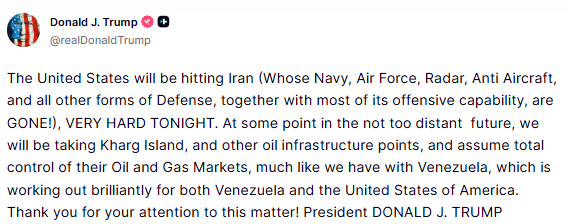
No diplomatic hedging. No carefully parsed State Department boilerplate. The President of the United States publicly declared Iran’s military capability destroyed — and announced he’s coming for the regime’s wallet next. Honestly? It’s about time.
A message Tehran can’t ignore
The sequence of events here matters. Iran shot down a U.S. Apache helicopter near the Strait of Hormuz. Previous administrations might have responded with a sternly worded letter to the United Nations and a vague promise to “review options.” Trump responded with cruise missiles. U.S. Central Command confirmed it launched strikes against multiple Iranian targets on June 10 at 5:15 p.m. ET — the same day.
When Iran’s regime declared the existing ceasefire “practically meaningless,” Trump didn’t flinch. He escalated. On Fox News shortly after posting to Truth Social, the president was characteristically direct: his preference has “always been to take Kharg Island.” Iran, he declared, is now “in submission.”
That’s not bluster. That’s a status report.
Cutting off the regime’s lifeline
Here’s why Kharg Island specifically matters. This single piece of Iranian territory handles roughly 90% of the country’s crude oil exports. It is the beating economic heart of the regime — the revenue stream that funds Hezbollah, Hamas proxies, and Tehran’s nuclear ambitions. Trump has it squarely in his crosshairs, and the U.S. Navy blockade already in place has dramatically choked Iran’s ability to ship crude.
The strategic elegance here deserves recognition. This isn’t a blueprint for another grinding Middle Eastern occupation. It’s economic strangulation backed by overwhelming firepower — the same model Trump applied in Venezuela, which he noted “is working out brilliantly” for both countries. Crush the revenue. Degrade the military. Force the regime to the table on American terms. No nation-building. No trillion-dollar tab for taxpayers.
The doctrine that works
Getting the strategy right matters even more when you remember how spectacularly wrong previous approaches went. The Obama administration shipped pallets of cash to Tehran under cover of darkness. Trump ships ordnance in broad daylight. That contrast isn’t just rhetorical — it represents two fundamentally different theories about how the world works.
This is the same president who brokered a 20-point peace plan that brought living hostages home after the Hamas atrocities. The pattern is consistent: project genuine strength first, then negotiate from a position no adversary can ignore.
The mullahs spent four decades gambling that Washington would always blink. They bet that American fatigue would outlast Iranian aggression. This week, at 5:15 p.m. Eastern Time, U.S. Central Command delivered the regime’s answer. The blinking is over.
UPDATE: The Mullahs called Trump later that day to request a deal, and after some posturing, Trump called off his blitz, looking forward to an imminent deal to be signed. Talk about effective.
Key Takeaways
- Trump ordered immediate strikes after Iran downed a U.S. helicopter — zero hesitation.
- Kharg Island handles 90% of Iran’s oil exports, making it the regime’s economic jugular.
- Economic warfare backed by military dominance beats appeasement — the Venezuela model proves it.
- Iran’s military is effectively destroyed; Trump is now dictating terms, not requesting them.
Sources: The Post Millennial, CNBC